
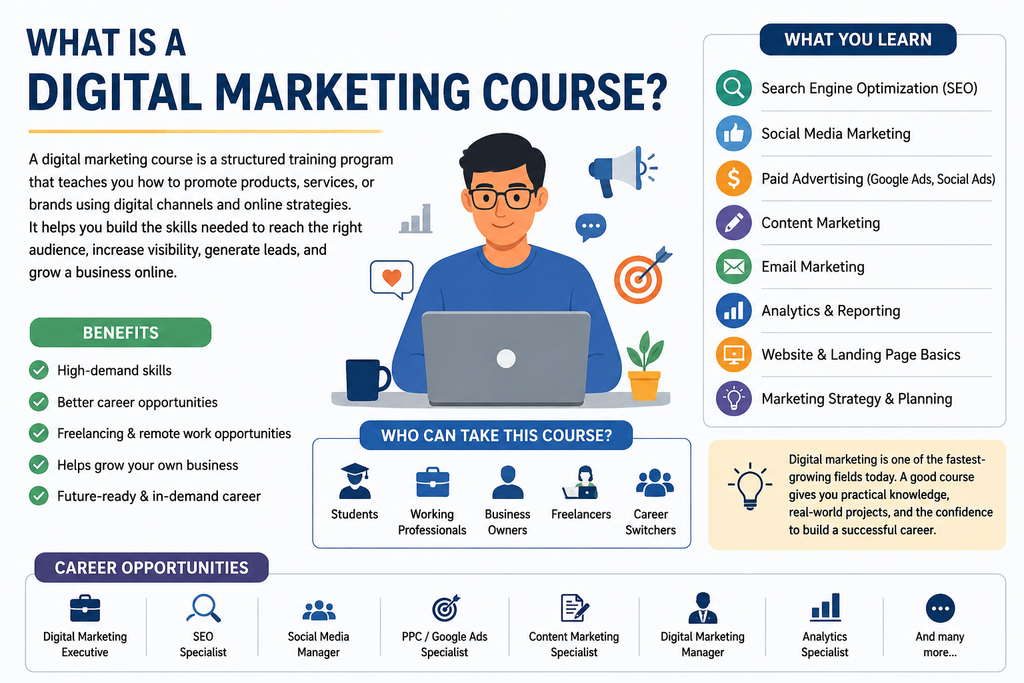
Cover the following areas comprehensively:
- What Is a Digital Marketing Course?
- Give a simple definition.
- Explain the purpose of the course.
- Explain how it helps students and professionals understand online marketing.
- Explain the difference between learning digital marketing independently and taking a structured course.
- Why Is Digital Marketing Important Today?
- Explain the growth of online businesses.
- Discuss how consumers search, compare, and purchase products online.
- Explain why businesses need digital channels.
- Connect digital marketing with business visibility, customer acquisition, engagement, and growth.
- What Do You Learn in a Digital Marketing Course?
Explain the major modules individually, such as:- Search Engine Optimization (SEO)
- Search Engine Marketing (SEM)
- Google Ads/PPC
- Social Media Marketing
- Content Marketing
- Email Marketing
- Affiliate Marketing
- Influencer Marketing
- Online Reputation Management
- Analytics and reporting
- Conversion rate optimization
- Lead generation
- Local SEO
- Mobile marketing
- Basic website understanding
- Branding and online presence
- Digital Marketing Course Syllabus
Provide a practical overview of what a typical syllabus may include.Explain that syllabus structures can vary between institutes, agencies, universities, and online platforms. - Practical Skills You Can Develop
Explain skills such as:- Keyword research
- SEO analysis
- Content planning
- Social media management
- Paid advertising
- Campaign planning
- Analytics
- Copywriting
- Audience research
- Competitor analysis
- Reporting
- Marketing strategy
- Who Should Take a Digital Marketing Course?
Explain how the course can benefit:- Students
- Fresh graduates
- Entrepreneurs
- Business owners
- Working professionals
- Freelancers
- Career switchers
- Marketing professionals
- Benefits of Learning Digital Marketing
Discuss:- Career opportunities
- Freelancing opportunities
- Business growth
- Better marketing knowledge
- Remote-work possibilities
- Entrepreneurial applications
- Understanding customer behavior
- Ability to measure marketing performance
- Career Opportunities After a Digital Marketing Course
Explain possible roles, including:- Digital Marketing Executive
- SEO Specialist
- SEO Executive
- Social Media Manager
- Content Marketing Specialist
- PPC/Google Ads Specialist
- Performance Marketing Specialist
- Email Marketing Specialist
- Digital Marketing Analyst
- Digital Marketing Manager
- Content Strategist
- Is a Digital Marketing Course Suitable for Beginners?
Give a clear answer.Explain:- Whether technical knowledge is required
- Whether coding is necessary
- What basic skills are useful
- How beginners can start
- Why practical learning matters
- How Long Does It Take to Learn Digital Marketing?
Discuss how learning time depends on:- Course depth
- Learning schedule
- Practical assignments
- Previous experience
- Individual learning speed
- Digital Marketing Course vs Self-Learning
Compare structured courses with self-learning.Explain the advantages and limitations of both approaches. - How to Choose the Right Digital Marketing Course
Provide a useful checklist covering:- Course curriculum
- Practical assignments
- Trainers’ experience
- Industry relevance
- Live projects
- Tools covered
- Analytics and reporting
- Certification
- Mentorship
- Placement/career support
- Reviews and reputation
- Course duration
- Learning format
- Why Practical Training Matters in Digital Marketing
Explain why students should not focus only on theory.Mention practical activities such as:- Creating campaigns
- Performing keyword research
- Building content plans
- Analyzing websites
- Creating social media strategies
- Working with analytics
- Understanding advertising dashboards
- How DGmark Agency Relates to Digital Marketing
Naturally introduce DGmark Agency as an example of a digital marketing-focused brand.Reference its relevance to areas such as:- SEO
- Social media marketing
- Performance marketing
- Local SEO
- Content marketing
- Website development
- Branding
- Frequently Asked QuestionsInclude 8–10 useful FAQs, such as:
- What is a digital marketing course?
- Is a digital marketing course good for beginners?
- What qualifications are required for a digital marketing course?
- What subjects are taught in digital marketing?
- Is coding required to learn digital marketing?
- How long does it take to learn digital marketing?
- What jobs can I get after a digital marketing course?
- Is digital marketing a good career option?
- Can I learn digital marketing without a marketing degree?
- Can digital marketing skills be used for freelancing?
- Conclusion
Summarize:- What a digital marketing course is
- What students can learn
- Why practical skills matter
- Who can benefit
- How readers can choose an appropriate course
Brand Integration Guidelines
Mention DGmark Agency naturally rather than repeatedly.
The article must not sound like an advertisement.
Use wording such as:
“DGmark Agency is one example of a digital marketing-focused brand that works across areas such as SEO, social media marketing, performance marketing, content marketing, local SEO, website development, and branding.”
Only include specific service claims that can be reasonably supported by the brand’s website.
Link the brand name naturally to:
Do not repeatedly insert the same brand link.
Tone and Writing Style
Use a:
- Professional tone
- Educational tone
- Neutral and trustworthy voice
- Beginner-friendly writing style
- Clear and conversational language
- Expert but approachable tone
- Objective third-party perspective
Avoid:
- Excessive promotional language
- Keyword stuffing
- Generic AI-sounding statements
- Repetitive paragraphs
- Fake statistics
- Unsupported claims
- Unrealistic career promises
- Guaranteed salary claims
- Guaranteed job claims
- Guaranteed business growth claims
- Overuse of adjectives
- Complicated jargon without explanation
Whenever a technical term is introduced, explain it in simple language.
E-E-A-T Requirements
Demonstrate strong:
Experience:
Use realistic examples of how digital marketing concepts are applied.
Expertise:
Explain concepts accurately and practically.
Authoritativeness:
Provide comprehensive topical coverage and clear definitions.
Trustworthiness:
Avoid exaggerated claims and distinguish general industry information from brand-specific information.
Do not fabricate statistics, certifications, awards, partnerships, client names, rankings, or achievements for DGmark Agency.
Examples
Include practical examples where useful.
For example:
If a local restaurant wants more customers, explain how local SEO, Google Ads, social media marketing, content, reviews, and analytics could work together.
If a student wants a digital marketing career, explain how learning SEO, paid advertising, analytics, content, and social media can create a foundation for different entry-level roles.
Use examples to make concepts easier to understand rather than simply adding theory.
Featured Snippet Optimization
Where appropriate, provide concise answers immediately after important headings.
For example:
What is a digital marketing course?
A digital marketing course is a structured learning program that teaches individuals how to promote products, services, brands, or businesses through online channels such as search engines, social media, websites, email, and digital advertising platforms.
Then expand on the topic in subsequent paragraphs.
Internal Linking Suggestions
Naturally identify opportunities where the publisher could internally link to relevant pages on the DGmark Agency website.
Potential topics include:
- SEO services
- Social media marketing
- Performance marketing
- Local SEO
- Content marketing
- Website development
- Branding
- Digital marketing services
Do not invent page URLs if they have not been verified.
Metadata
After the article, provide:
SEO Title:
A compelling title of approximately 50–60 characters where practical.
Meta Description:
Approximately 150–160 characters and naturally include the primary keyword.
Suggested URL Slug:/what-is-a-digital-marketing-course/
Primary Keyword:
What is a digital marketing course
Secondary Keywords:
List 8–12 relevant secondary keywords.
Content Quality Checklist
Before finalizing the article, verify that:
- The article is approximately 3,000 words.
- The primary keyword appears naturally.
- The introduction answers the main query quickly.
- The content matches informational search intent.
- The article is useful for beginners.
- All major digital marketing disciplines are explained.
- The course syllabus is covered.
- Career opportunities are explained realistically.
- No unsupported statistics are included.
- No fake claims about DGmark Agency are included.
- DGmark Agency is introduced naturally.
- The writing does not feel overly promotional.
- Headings are logically structured.
- Paragraphs are easy to scan.
- Lists are used where helpful.
- FAQs address real beginner questions.
- The conclusion summarizes the article effectively.
- SEO metadata is included.
- The article demonstrates expertise without unnecessary jargon.
- The content is original and does not imitate another website.
Final Output Format
Produce the final response in this order:
- SEO Title
- Meta Description
- Suggested URL Slug
- Primary Keyword
- Secondary Keywords
- Full approximately 3,000-word blog article
- FAQs
- Final SEO/content quality checklist
Write the article as a high-quality educational brand blog, not as a sales page.
The final article should make a beginner finish reading with a clear understanding of what a digital marketing course is, what it teaches, why it matters, who should take one, what career opportunities it can support, and how to choose the right course.